Pollution may be the Achilles ’ heel for the sugar industry
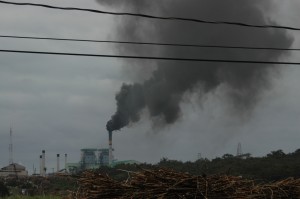 Sugar production is still not at its projected capacity; the factory at Tower Hill is expected to mill six thousand tons daily but it is down to just over five thousand tons. The season got off to a slow start due to technical difficulties with the launch of BELCOGEN. But aside from the delays, there is another problem that residents in the factory area are experiencing. The BELCOGEN plant is emitting dust, smoke and pollution that are affecting the livelihood and health of nearby residents. News Five’s Delahnie Bain headed to the sugar belt today and files this report.
Delahnie Bain, Reporting
The cloud of black smoke that is emanated from the Tower Hill Sugar Factory during the cane season is an issue that residents in the surrounding areas have battled for years. But the introduction of the BELCOGEN project promised an ease in the air pollution, as the Project Director explained to News Five in an interview in 2007.
Via Phone: Richard Harris, Project Director, BELCOGEN (March 21st, 2007)
“BELCOGEN is designed to significantly reduce the environmental footprint of the B.S.I. group in Belize. The power plant will have installed electrostatic precipitators to dramatically reduce the flash that is currently sometimes a problem. And because our financiers are international financiers we have accepted to sign up to various environmental standards that accord really with World Bank environmental standards for power stations so that the environmental performance will be meeting the World Bank standards.”
But the BELCOGEN plant came on-stream at the start of 2010 and to date it is showing that there will be ashes flying from the factory, not just during grinding season, but throughout the rest of the year. The Belize Sea Island Cotton Growers is located just across from the entrance to the factory and the smoke and ashes are affecting their products.
Roberto Salas, Employee, Belize Sea Island Cotton Growers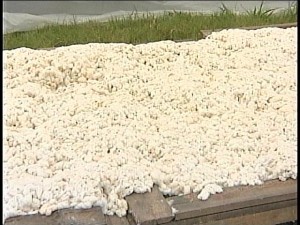
“We do cotton production and mostly when we do the drying process the ashes that is brought through with the breeze it drops in the cotton and stains our production. So it actually messes up our quality of production. One of the reasons too, not only here but in the farm especially when we have the breeze blowing this side towards our farm—we plant cotton on that side of the highway—the ashes that fly through messes up the cotton and the people who are working for us also get a lot of mess on the job.”
According to cotton growers, Roberto Salas and Hector Lopez, they have been grappling with the situation for about seven years and it also poses a threat to their health.
Roberto Salas
“Health wise, I think that’s one of the reason why are always with fresh colds and what’s not. The one from last week, the smoke was that strong that we needed to wear masks and goggles for the eyes for the smoke not to get into our eyes. My boss, Mr. Inoue, had to sleep in a hotel for that night because the smoke was that terrible; very bad.”
Hector Lopez, Supervisor, Belize Sea Island Cotton Growers (Translated)
“I think that it affects the workers because when they are working their skin gets black. It affects their vision as well because the ashes go into their eyes. But when they leave they’re all covered in black.”
The situation has escalated to the point where a small restaurant next to Belize Sea Island Cotton Growers has had to close its doors because the area is not sanitary enough for food preparation. While they still have their jobs, the cotton growers say something needs to be done.
Roberto Salas
Roberto Salas
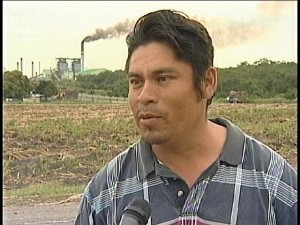
“I do believe that they need to come up with better ideas or new ideas on how to prevent too much pollution in the area. Like I said before, not only the cotton production getting affected, but also the Chan Pine Ridge, Carmelita, Tower Hill and Palmar Villages get affected by the ashes and the smoke.”
Hector Lopez
“A new company needs to put in another system and I think that will eliminate this problem but it doesn’t seem that they will do it. When the fumes blow over here it hurts because the diesel burns.”
The workers are hoping to breathe a sigh of relief in the near future, but at this point it seems that all they can expect is more polluted air. Delahnie Bain for News Five.
News Five tried to reach representatives from BELCOGEN for a response to the environmental concerns, but we were told they were not available for comment.

What about the river? Is anybody monitoring the river?
This is where the Environment Department comes in. They should be monitoring these kinds of development as guidelines should have been placed in the Environmental Compliance Plan to safeguard against this sort of pollution. As I understand it the Environmental Impact Assessment made strict recommendations for scrubbers to have been put in place to prevent such pollution. The outcome with such equipment in place would have resulted in almost zero emmitance of dust and smoke. DOE needs to stop globe trotting, stop calling so much workshops, get off their butts and do their monitoring. They are paid fees to do monitoring. What are they doing?????? LIVING IT UP?
The solution to the problem is a multi-million dollor investment, something that is not easy to come by these days. The solution lies with the installation of either a scrubber or electrostatic precipitator or a combination of both. For the meantime, the smoke poses a serious health risk to villagers downwind as well as economic impacts to produce. Its imperative that these issues are addressed. As to the DOE’s input, I think they don’t have the capacity or knowledge to deal with the problem, especially the ones with the fish kill. Both DOE and BSI need more educated and qualified personnel to address these issues.
BELIZE SUGAR INDUSTRY MANAGER SHOULD BE CHANGED NOT BEING ABLE TO GIVE A SOLUCION. THE ENTIRE INDUSTRY IS COLAPSE AND DEFINATELY THERE IS A SOLUTION RETURNING TO THE OLD SYSTEM. I BELIEF THAT THE WANT TO MAKE BELCOGEN WORK AT THE COST IT TAKE.
CANE FARMERS AND WORKERS DO NO HAVE EVEN THER BASIC FOOD NEED AND THE ARE GOING TO LOSE THERE CROP.
GOVERMENT SHOULD HELP GIVE A SOLUCION BECAUSE THIS CANNOT CONTINUE.