Get ready to be counted on Census Day
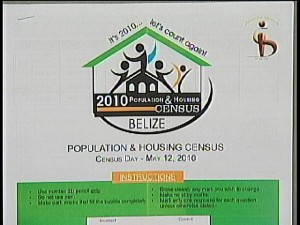 Every ten years, the population is counted. The census determines a number of issues and provides updated information on population growth and trends, gender, race, employment and other interesting data on the Belizean mosiac. Census Day has been set for May twelfth, when every household will be visited and tallied. Ann Marie Williams has more on the process of the census.
Ann-Marie Williams
“The 2010 census is a new portrait of Belize. It’s essentially a stocktaking exercise when we look back ten years to see if we’ve progressed or regressed in several areas, among them education, health, housing, environment, employment and quality of life.”
Ann-Marie Williams, Reporting
The census has had a long and storied history in Belize, dating back to the early days of the settlement when censuses were conducted on Christmas Day and at night. The first was done in 1816. When the last census was done ten years ago, 32,000 people living in Belize were foreign born, the PUP were in power, a dollar bought a loaf of bread and premium gas was five dollars, seventy-five cents per gallon. A lot has changed since then and that’s exactly what the 2010 Population & Housing Census wants to capture using a questionnaire which is divided into two parts—the household level and the individual. Census Officer, Glenn Avilez of the Statistical Institute of Belize speaks of how a household is defined.
Glenn Avilez, Dir. Gen., Statistical Institute of Belize
“A group of persons living together for four days or more in the week and by living together it means that they sleep and eat together. So you could have a household of family, persons related by bloodline; you could have a household of persons that are not related. So two persons boarding in the same house, going to school together, not related could be considered a household or you could have a single person household.”
On census day, May twelfth, all will be counted except members of the B.D.F. or British Forces living in barracks and foreign diplomats. Students studying abroad will also be counted as part of the household. Prisoners no—they will be counted where they are. For individual level data, enumerators will ask for the person’s name, age, sex, ethnicity, religion and their relation to the head. Miriam Willoughby is the Deputy Census Officer.
Miriam Willoughby, Deputy Census Officer
“We’re also looking at economic activity for persons fourteen years and older; people who can legally work; questions relating to whether they’re employed or not. This is where we will get our Labour Force information from; whether they’re working or not; people who may not be working but are willing to work.”
Under the education and training section enumerators want to engage people from two to one hundred and two, all in an effort to capture children at the preschool level, an area in which Belize lags behind but not unlike the Caribbean. The Education Statistical Digest of 2006, reminds us that Belize’s net preschool enrollment stands at an unacceptable thirty percent. Growing research, however, shows that adequate early childhood education interventions can help equalize opportunities for low income children and their families in Belize. Some new question sections have also been added to the census among them, the role of women.
Miriam Willoughby
“How people feel about women being in political leadership. We have several categories such as senators, village council, chairpersons; different political levels and what is the perception. Also you would like to look at the demographic composition of the persons who feel whether yes they should or no they should not be in political leadership roles.
Ann-Marie Williams
“I know that question also includes the transformation leadership because you have CEOs, women serving on boards.”
Miriam Willoughby
“Right, overall in leadership roles; how do people feel about women being in these roles?”
Aware that these kinds of baseline data necessary to plan for women in politics and decision-making do not exist, the National Women’s Commission was instrumental in securing the questions. To make data gathering easier, the country will be divided into enumeration districts and each enumeration district will consist of one hundred to one hundred and fifty households. Besides data, the census promises new employment.
Ann-Marie Williams
“This hiring of one thousand people or more, how will it impact the Labour Force Survey?”
Glenn Avilez
Glenn Avilez
“Definitely a lot of these people would have been otherwise unemployed, so that period of the census will certainly increase—assuming that all other things remain the same because if there are no other changes in the economy then yes, it will increase the number of persons employed and so decrease the unemployment rate, which will be good. Unfortunately it will only be for a short period.”
Dennisha Lewis
“I know that the census takes place every ten years and it helps the government to find out the amount of people living in a country, the birth rate, the death rate.”
Joseph Sanchez
“I don’t really nothing about di census. I haven’t heard about it.”
Stacey Grinage
“It’s being held this year and they are going to go around and ask you for particular about your family and how much people live in your house and things like that.”
Ann-Marie Williams
“The data for the most part should inform policy planning and in effect produce a better quality of life when we can really use that data to effect change. We look at the censuses over the Caribbean, particular in the states, a lot of what they do the census is tied to resources. How are we with that in Belize?
Glenn Avilez
Unlike the States, there is no police or there is no mandate that based on results that resources should be geared or targeted to areas that are most in need. In the states, there is that need as well as practice where immigrant populations, they would be located in a particular area and because of the increase in that population, then while it is not targeted at the immigrant population, it is targeted at the area, they as a result would benefit. For us, there’s nothing in our policy or the policy of the government that because the population of Toledo has grown by forty percent that they should get forty percent more resources.”
Mindful of slippages, missed opportunities and gaps as bore out over the last ten years by The Multiple Indicator Cluster Survey, the MICS of 2006, the Labour Force Survey and the draft poverty assessment released last month; all these data serve as a lens within which the 2010 census can be viewed.
Glenn Avilez
“What we have seen for most of this decade is that unemployment has hovered around 8-9%. In the recent year 2009, it was upwards of 13%. Of course we can attribute that to the deterioration in the world’s economic position. We hear about the recession.”
The 2010 Population & Housing Census is a huge stock taking exercise which promises to deliver accurate information about our diverse and growing population and its importance to the future of every community and by extension country. It’s 2010—Let’s Count Again! Ann-Marie Williams for News Five.
Enumerators will be visiting homes at random to do a pre-testing of the census questionnaire on February twenty-second to twenty-fourth. The purpose of this exercise is to ensure that respondents understand the questions that they will be answering. If the questions are not understood, the Statistical Institute of Belize still has time to make the necessary changes before Census Day. Enumerators will also be visiting these sampled households again, during the census.
