Forecasting 2010’s Primary School Examination result
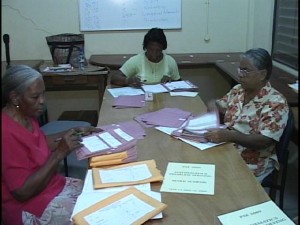 Students who recently sat the PSE are anxiously awaiting the results but teachers are worried that performance in one of two core subjects is significantly below their expectations. Math has long been a problem subject for most primary and secondary school students and their shortcomings in that discipline is evident in the PSE. The exams have been graded and News Five’s Isani Cayetano spoke with the teachers to find out what we can expect from this year’s results.
Isani Cayetano, Reporting
Part two of the Primary School Examinations were corrected over the past weekend and while educators commend students for improvement in English, there are still major concerns over their performance in Mathematics. Of note is that the format for Paper Two which consists of problem solving questions has remained constant for the past ten years and students still struggle with answering the problems correctly.
Nelson Longsworth, Director of the Quality Assurance and Development Services, says students are still having a hard time understanding the fundamentals of mathematics.
Nelson Longsworth, Director, QADS
Nelson Longsworth
“It is clear that we will continue to see deficiencies from the results. We see where children sitting the exams lack specific skills. In an overview you have those who do extremely well; extremely well in the sense that they practically ace the paper and then you still have a large group that struggles with many of the items because the exam spans across many of the mathematic curriculum and I think at the end of the day it’s showing, the results do show that children are not grasping, they’re not mastering it and what exactly causes that of course is a varied number of factors. The math curriculum speaks to children being able to problem solve as one of the major skills and this paper definitely shows that we still have a lot to do in that area of problem solving.”
In the English Paper Two there has been marked improvement and according to Emilio Pott less students are performing below average in the examinations.
emilio pott
Emilio Pott, English Teacher
“Well I guess generally the paper, the English paper was well done in the sense that we had much less people getting below the average. Most of the papers were average, we had a few proficiency and excellent but the majority of the papers were in the stage where it is okay.”
Isani Cayetano
“Were there any specific trends that you would have noticed correcting these papers?”
Emilio Pott
“Well one of the main issues that we found with the papers is that the children had a lot of problem with spelling.”
Isani Cayetano
“What are some of the corrective measures that can be taken at the primary level to address this specific problem and any others that may be found at the stage where the kids are taking the Primary School Examination?”
Emilio Pott
“I think basically, as teachers, we need to spend a lot of time in getting children to really spell properly because we find that with the Creole and other languages that might be their first language is really hindering them from writing proper English.”
Over six thousand eight hundred primary school students across the country sat the exams this year and it is expected that the results will be out by the end of next week. Reporting for News Five, I am Isani Cayetano.

What really worked for me is when there used to be spelling b’s but all the class would get a long sheets of words and expected to study and then they would choose the best. That motivates, then in class too we had every term a whole exam on spelling, don’t know if they are still doing it now, but it did helped me. I believe I’m a good speller lol
those old arithmetic drills helps a lot, most importantly let us concentrate on teaching children to read and write, besides spelling I very much agree with Ms. Eve.
Most children don’t like maths and if the teacher is impatient it makes matters worst. Minister of Education please look into this matter some Std. VI math teachers expect that every topic they teach the student they should already know. In some cases it’s the first time they are working with problem. Instead of trying the help these children some of the teachers start calling them names and instill fear into their hearts which make matters worst. Look into matter please and you will see this is a complaint from many parents and students.
i think that teachers from Std I need to be evaluated because certain topic that they should cover in Std I they don’t. So when your child move onto Std II the teacher will be teaching something that the child haven’t seen. i.e if in std i you’re doing addition then when you go in std II you should be taught subtraction etc, and don’t go back to the same addition. addition can be implemented with other work. Each teacher should know or work together to know exactly what is being taught the grade below and the grade above to properly prepare our students. Even in Std VI they should be touching a few topics that will be taught in first form…………